 +91 8882677955
 +91 8882677955

Blog
AI in Financial Auditing: How Is It Changing the Work of Auditors?

Think about how many transactions a company handles in one month. Payments, purchases, expense claims, journal entries. Thousands of them, all landing in the books. When audit time comes, somebody has to confirm those records are right and that the financial statements deserve to be trusted. AI in Financial Auditing is helping transform how this process is carried out.
That was never an easy job.
For years, auditors worked with samples. They picked a set of transactions, pulled out the invoices, payment records and approvals, and decided whether things looked reasonable. Plenty of firms still work this way. The catch is obvious, though: whatever isn’t in the sample doesn’t get looked at.
That’s starting to shift. Financial software can now run through far bigger sets of records and point to the entries that need a closer look. A duplicate payment, an odd expense, a transaction booked at a strange hour: these are much easier to catch when a tool is comparing thousands of entries side by side.
Companies have noticed. In a 2024 KPMG survey of 1,800 companies, 72% said they were already piloting or selectively using AI in financial reporting.
So if software takes on more of the checking, what are auditors actually left to do? Looking at a real audit makes the answer clearer.
How Is AI in Financial Auditing Transforming the Audit Process?
Picture a company with hundreds of suppliers. Its accounts team receives invoices, verifies bills, books expenses and releases payments all month long.
Now say two employees both enter the same invoice by mistake. Both payments go through, and the supplier gets paid twice.
In a traditional review, an auditor might stumble on this while checking sampled transactions. If that invoice wasn’t sampled, the error could sit there for years.
Analysis software doesn’t have that problem. It can compare invoice numbers, amounts, supplier details and dates, and if two entries look suspiciously alike, it flags them. The auditor then opens the original documents and works out whether it’s a real error.
That’s the role AI plays here. It finds things that would otherwise take ages to find. The decision still belongs to the auditor.
Beyond catching duplicate payments, these tools can also:
- Compare entries made by different departments
- Spot sudden jumps in expenses
- Go through large piles of invoices and contracts
- Point out missing information in records
- Highlight transactions that break company policy
- Draft summaries of the information gathered during an audit
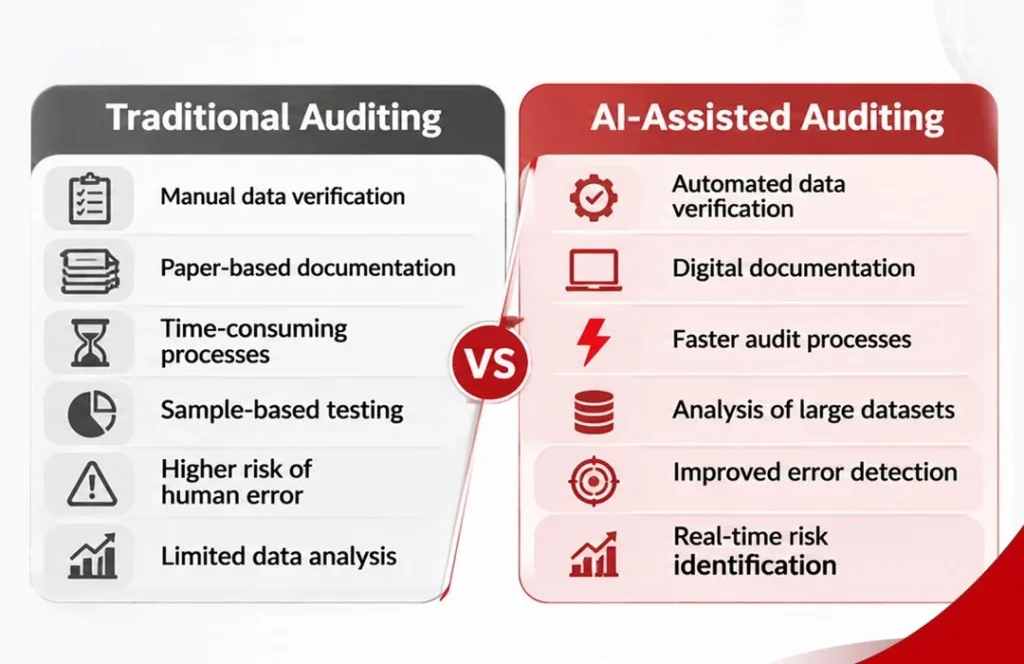
Traditional Auditing vs AI-Assisted Auditing
The goal of an audit hasn’t changed: look at the financial information and decide whether it’s fairly presented. What’s different is how some of the work gets done.
| Area | Traditional auditing | AI-as sisted auditing |
| Transaction checking | Usually based on samples | Can cover much larger populations |
| Invoice review | Mostly checked by hand | Software helps compare details |
| Finding errors | Depends on what was selected | Unusual entries get highlighted |
| Timing | Often follows a periodic schedule | Some checks can run more often |
| Documents | Read and sorted manually | Details can be extracted automatically |
| Auditor’s role | Checking, investigation, judgement | Investigation and judgement still matter most |
One caution here. Checking every transaction doesn’t make an audit perfect. Software can miss something important, or flag an entry that’s perfectly fine. Auditors still need to understand what they’re looking at.
Four Everyday Situations Where AI Can Help Auditors
It’s easier to see the value of these tools through real accounting problems.
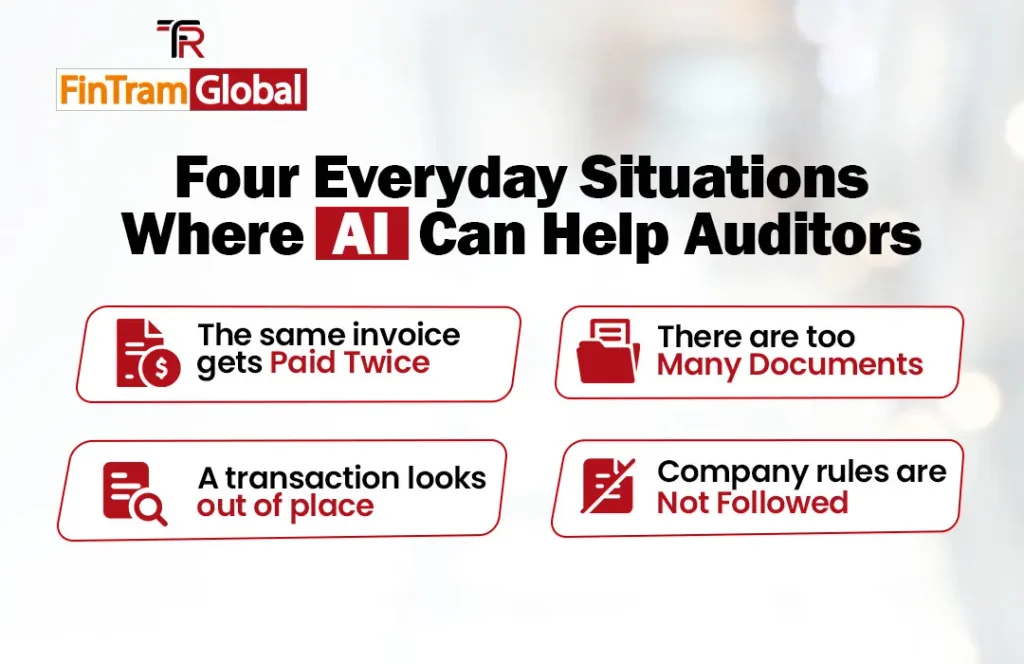
1. The same invoice gets paid twice
It is a very common mistake to pay twice. These are caused by data entry slips, miscommunication between staff or by processing an invoice more than once.
Say a supplier sends an invoice for ₹45,000. One employee records it. Another, unaware of that, records it again. If both get processed, the supplier is paid twice.
A system that compares invoice details can put the matching entries in front of the auditor, who can then check the payment records and supporting documents.
2. A transaction looks out of place
Suppose a supplier usually gets paid between ₹20,000 and ₹50,000. Then one month, a ₹6 lakh payment shows up.
There might be a good reason, like a much bigger order. But an auditor would want to know before moving on.
Software that studies past transactions can highlight that gap. The team gets a clear reason to investigate, instead of combing through every payment by hand.
3. There are too many documents
A single audit can involve hundreds of invoices, agreements, purchase orders and bank statements. Hunting for one specific detail across all of them eats up working hours.
Document-reading tools can pull out dates, amounts, names and contract clauses. Auditors can use that to find the right documents faster and check whether the records agree with each other.
4. Company rules are not followed
Approval Rules Most businesses have approval rules. For example, a payment over a certain amount may require the sign-off of a senior manager.
If a payment is made without that approval, it could signal a weakness in the company’s internal controls.
Financial systems can pick up such entries. The auditor then checks who approved the payment and whether the company followed its own procedure.
What Do the Research Figures Tell Us?
KPMG 2024 Survey Findings
| Survey finding | Result |
| Companies already piloting or selectively using AI in financial reporting | 72% |
| Expected adoption within three years | 99% |
| Companies expecting auditors to review AI-related controls | 64% |
| Companies planning to use generative AI in financial reporting within three years | 57% |
Keep in mind that these are 2024 survey results and expectations. The 99% figure is what companies expected back then, not a confirmed adoption rate today.
The 64% figure is the one to think about. Nearly two-thirds of the companies expected auditors to look at the controls around AI. So an auditor’s job may include understanding how the systems behind the financial statements work, on top of checking the statements themselves.
What Does This Mean for an Auditor’s Daily Work?
Many people assume AI just makes an auditor’s life easier. That’s only half true.
Some tasks will get faster, especially repetitive calculations, document comparisons and transaction reviews. But the time saved tends to go into deeper investigation.
Say the software flags an unusual journal entry at year end. The auditor can’t just label it an error and move on. They’d need to ask:
- Who entered it?
- Did the right person approve it?
- Is there a supporting document?
- Why was it booked at that particular time?
- Does it affect the financial statements?
Answering these takes real knowledge of accounting and of the business behind the numbers. The software can draw attention to the entry, but the investigation is still the auditor’s job.
Are There Any Risks Involved?
Yes, and businesses need to be careful, especially when financial records are involved.
- Confidentiality. Accounting records hold supplier details, employee information and other sensitive data. Companies need to know where that data is stored and who can get to it.
- Wrong results. A system might flag a genuine payment, or miss a real mistake. Its findings have to be checked against the original records.
- Hard-to-explain flags. If an auditor can’t tell why a transaction was flagged, documenting the finding gets tricky.
- Old systems. Some businesses still run software that doesn’t connect easily with newer analytical tools.
- Responsibility. Accepting every result without checking is its own kind of problem. A computer-generated result should never be treated as final evidence.
Will AI Replace Auditors?
Accounting students ask this a lot, especially those heading for audit firms after qualifying. It’s a fair worry. If software can check thousands of transactions, write summaries and spot unusual entries, will firms still need as many auditors?
But auditing is a lot more than finding differences in numbers.
Say a system flags a payment to a supplier the company hasn’t dealt with in years. The software can highlight it. Someone still has to find out why it was made. Was it an old unpaid bill? Was the supplier account reactivated? Did anyone approve it? Are the documents genuine?
An auditor has to answer these before reaching any conclusion. Then there are conversations with management, reviews of internal controls and calls that need professional judgement. Comparing figures can’t do any of that.
The work will change. But people who understand accounting, business operations and audit procedures will still be needed.
What Should Students Learn to Prepare for the Future?
If you’re entering the profession, it’s smart to keep an eye on how businesses handle financial information. But don’t skip the basics just to chase every new technology. A few skills are especially useful:
- Accounting and financial reporting. Understand the recording of transactions and the convergence of financial statements. Otherwise, audit findings are meaningless.
- Excel and data handling. Get comfortable with spreadsheets, formulas, pivot tables and large sets of financial data.
- Auditing and internal controls. Understand why companies have approval procedures and how auditors test compliance with these.
- Accounting software. Get familiar with the tools companies use to keep their books.
- Communication. Auditors often have to explain a problem to someone with no accounting background. Saying it clearly matters.
These skills help whether you end up in an audit firm, an accounts department or a corporate finance team.
Choosing the Right Professional Qualification: ACCA or US CMA?
Students looking at finance careers usually end up comparing ACCA and US CMA. Both are respected professional qualifications, but they cover different ground.
ACCA suits students drawn to financial accounting, audit and assurance, taxation and financial reporting. Its syllabus shows how businesses prepare their financial statements and how auditors examine them.
US CMA leans toward management accounting, financial planning, performance management, internal controls and business decision-making. It fits students aiming for management accounting and corporate finance roles.
At FinTram Global we help students to achieve ACCA, US CMA and other qualifications. We walk them through the course structure, subjects and career options so they can decide based on their own interests and plans.
If you’re thinking about a career in auditing, getting the accounting fundamentals right is a sensible first step. Once you understand how businesses actually use financial information, it’s much easier to adapt as the profession changes.
conclusion
An auditor’s job has always been about more than checking whether the numbers in a report add up. It’s about understanding how those numbers were recorded, asking questions when something feels off, and making sure there’s enough evidence to back up a conclusion.
Technology is changing how some of that work gets done. Routine checks may get quicker, and auditors may have more information in hand when they look at a company’s records.
For students planning to enter the profession, the best investment is still a solid understanding of accounting and auditing. Learning to work with modern financial tools adds to that foundation and helps you keep pace with how businesses work.
Frequently Asked Questions
1. Should accounting students be taught AI?
A rudimentary knowledge of modern financial instruments helps. Develop strong accounting knowledge, data analysis skills and a good understanding of internal controls.
2. Is ACCA a good option for students who want to make a career in auditing?
Yep. ACCA covers audit & assurance, financial reporting and professional ethics. So it suits well for audit and accounting careers.
3. Are there AI financial audits for small businesses?
Yes. They can begin on a small level with invoice matching, payment verification and expense reviews. The software must be the right size and fit for the business.
4. What is the difference between ACCA and US CMA?
ACCA focuses on financial accounting, audit and assurance, taxation and financial reporting. US CMA focuses on management accounting, financial planning, performance management and strategic decision-making.