 +91 8882677955
 +91 8882677955

Blog
ACCA AAA: A COMPLETE GUIDE TO CLEAR THE EXAM

The ACCA Advanced Audit and Assurance (AAA) Exam, is a popular exam choice by students when it comes to the ACCA optional papers. This is because of the fact that it visits the audit and assurance concepts in detail and requires the students to apply their knowledge in practical audit scenarios and use judgement to take decisions and conclusions on the relevant audit situation.
So, let’s have a look at the AAA Exam Syllabus in detail:
ACCA AAA Syllabus
The paper builds up on the fundamental audit concepts and methodologies covered in its predecessor examination Audit and Assurance (AA) and further adds on to other review engagements. The syllabus is divided into nine Syllabus areas:
1. PART A – Regulatory Environment:
This syllabus area covers the basic concepts of the audit and builds on the rules, regulations and principles followed by auditors’/audit firms in conducting the audit.
2. PART B – Professional and Ethical Considerations:
Ethics or in other words doing the right thing is considered to be one of the most fundamental principles that the auditor should be following. In this syllabus area, the ethical principles and threats, and various situations that can give rise to an ethical dilemma and how the auditor deals with each situation are covered.
3. PART C – Quality management:
Auditors deliver a professional service and one of the key things that they should ensure is that they should provide their services at the utmost quality without any issues, both as an individual and as a firm. This is exactly what is covered under this syllabus area.
4. PART D – Planning and conducting an audit of historical financial information:
This syllabus area covers the overall process of audit from Planning to Execution and also requires students to revisit the IFRS Standards thoroughly. This is because students will be required to identify audit risks and other issues with the knowledge of the IFRS standards.
5. PART E – Completion, review and reporting:
This part looks at the audit conclusion phase and how the independent auditor’s report should be drafted and the various opinions provided by auditors.
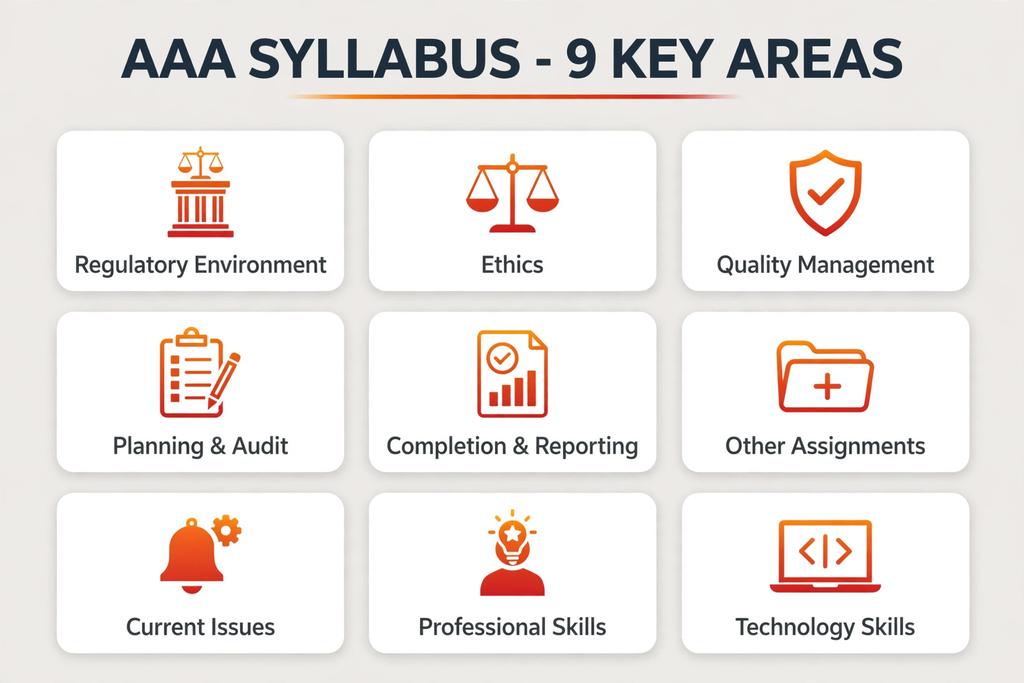
6. PART F – Other assignments:
As we all know external audit is not the only service provided by an audit firm. There are also services like review of prospective financial information, due diligence review, forensic audit, etc. which are looked at more closely under these sections.
7. PART G – Current Issues and Developments:
This syllabus area focuses on the issues and affairs that are impacting the current audit industry and involves aspects such as the impact of AI and Data Analytics in Audit, Sustainability and any changes/modifications made to the audit standards.
8. PART H – Professional skills:
The marks for professional skills would be provided for Communication, Analysis and evaluation, Professional Skepticism and Judgement, Commercial acumen in the AAA exam.
9. PART I – Employability and technology skills:
These are just the basic computer skills which are required in order to write the exam.
Now that we have understood the syllabus, let’s have a look at the exam pattern:
ACCA AAA Exam Pattern
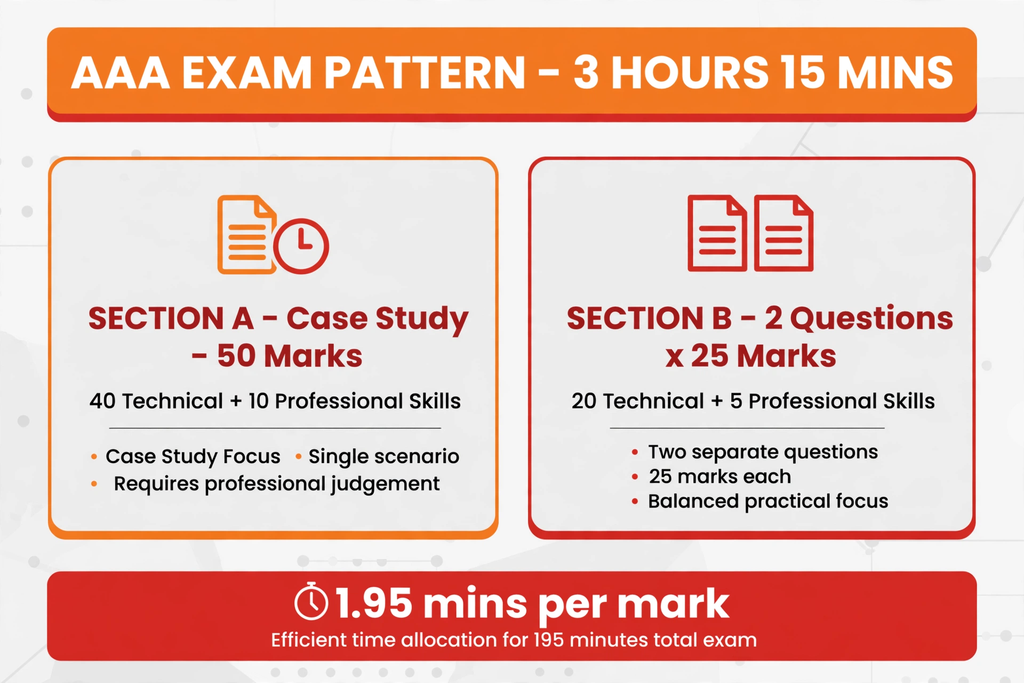
The AAA exam is a 3-hour 15 minutes exam which is constructed in 2 sections.
Section A
Section A will comprise a Case Study, worth 50 marks, set at the planning stage of the audit, for a single company, a group of companies or potentially several audit clients. Candidates will be provided with detailed information, which will vary between examinations, but is likely to include extracts of financial information, strategic, operational, and other relevant financial information for a client business, as well as extracts from audit working papers, including results of analytical procedures. The 50 marks will comprise of 40 technical marks and 10 professional skills marks. All professional skills will be examined in Section A.
Candidates will be required to address a range of requirements, predominantly from syllabus sections A, B, C and D, thereby tackling a real-world situation where candidates may have to address a range of issues simultaneously in relation to planning, risk assessment, evidence gathering and ethical and professional considerations. Please note that other syllabus areas, excluding E, may also be drawn on as part of the Case Study.
Section B
Section B will contain two compulsory 25-mark questions, with each being predominately based around a short scenario which may relate to more than one client. The 25 marks will comprise of 20 technical marks and 5 professional skills marks. Section B questions will examine a combination of professional skills appropriate to the question. Each question will examine a minimum of two professional skills from analysis and evaluation, professional skepticism and judgement and commercial acumen One question will always predominantly come from syllabus section E, and consequently candidates should be prepared to answer a question relating to completion, review, and reporting. There are a number of formats this question could adopt, including, but not limited to, requiring candidates to assess going concern, the impact of subsequent events, evaluating identified misstatements and the corresponding effect on the auditor’s report. Candidates may also be asked to critique an auditor’s report or evaluate the matters to be included in a report which is to be provided to management or those charged with governance.
The other Section B question can be drawn from any other syllabus section, including A, B, C, D and F.
We looked at the Syllabus and the Exam Pattern, now let’s think on how to crack this exam:
ACCA AAA Exam Preparation
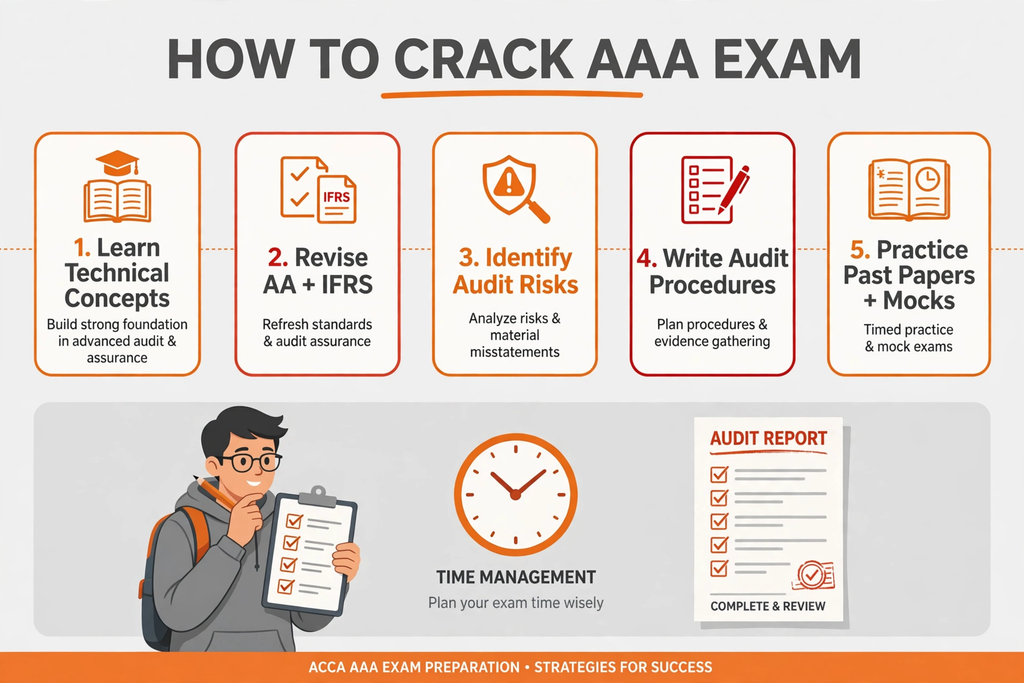
1. Build a Strong Understanding of the Technical Syllabus:
The first step is to obtain an in-depth understanding of the technical knowledge of AAA. This is the proper ‘learning’ phase where you understand the theoretical concepts and standards. Learning is not a one day or one week process. There should be an ample amount of time dedicated to learning the syllabus content and it does not stop at that. We are all humans who tend to forget things. Therefore, it is important that you revise the concepts on a regular basis so that we do not forget them.
2. Revise Your AA Fundamentals:
As mentioned earlier, AAA has a lot of topics which are directly carried forwarded from its predecessor AA. Therefore, it is important that we also revise the AA syllabus content and the IFRS standards regularly as well. The IFRS standards will be tested at an SBR level, therefore, it is important to attend this exam either with or after the SBR paper.
3. Master the Art of Identifying Audit Risks:
One of the common challenges faced by ACCA students when it comes to the AAA exam is that they are able to identify the Audit risk from the scenario, however, they are not able to put it into words. The audit risk related question in Section A carries 50 marks majority of which is related to the question which requires you to identify the risk of material misstatement, explain why there is a risk and provide the impact of the risk on the financial statements. This is exactly how you should structure your answer:
– Identify the Audit risk:
The first step is to identify the risk from the audit scenario. A common mistake that students make when it come to identifying the risk is that they tend to write business risks instead of audit risks. An easy way to get around this issue is to think of the impact on the financial statements rather than the company.
For example, let’s assume that the student identified a risk from the scenario in relation to going concern. If you think about it, this instance can be looked at in 2 ways. If the student writes that the going concern issue can lead to the business eventually shutting down, then is it an audit risk? Answer is No. However, if I say that the management’s assessment of going concern is incorrect and there is a risk that the financial statements should have been prepared on a break-up basis rather than going concern basis, then it can be considered to be an audit risk. Here, the impact on the financial statements is clearly communicated.
– Explaining the risk and impact:
So how can one explain an audit risk? One important thing that the student should know is that they should not waste time in the exam over explaining the accounting or audit concepts. The idea here is to briefly explain the risk which arises from the identified risk and the impact of that within the financial statement. Impact would be an overstatement or understatement in the key financial accounts like the Revenue, Profits, Assets, Liabilities, etc. Always keep the explanation within 1 or 2 lines and mention any accounting principle where applicable.
4. Learn How to Design Effective Audit Procedures:
Audit procedures are quite easy to learn theoretically, however, when it comes to practically designing audit procedures, students tend to face a lot of challenges. Some of the common problems that were highlighted in a lot of ACCA examiner’s report were that students usually tend to write procedures which are either not really feasible or they are too vague and does not specifically say what the auditor must do. You have to view the audit procedure as an instruction which you are giving to a junior auditor. Let’s assume that your audit supervisor is telling you to ‘Check the revenue figures’, what exactly will you do? Pretty sure you will be quite confused. However, if you specifically say ‘Select a sample of sales transactions from the sales ledger and inspect customer orders, sales invoices, dispatch notes and proof of delivery to verify that the recorded revenue relates to genuine sales transactions’, then the junior auditor is clear on what he has to do, which assertion is he testing and why he is testing it. This is exactly how every audit procedure should be structured. It has to say ‘What specifically needs to be done? And why we need to do it?’.
Further, the practicality of the procedure should also be considered. In the previous procedure mentioned, we have specifically mentioned, ‘Select a sample of sales transactions’, this is because we know that it is not practical for an auditor to go through every single transaction one by one. Therefore, we say lets just test a sample of items representative of the population. Considering these 2 aspects can greatly help the student to design an appropriate audit procedure, rather than writing pre-learned procedures.
5. Give Special Attention to Audit Reporting:
Another common question that is seen in the exam is in relation to drafting the Independent Auditor’s Report and providing an opinion on certain audit issues. It is common of AAA exams to contain a question that requires you to go through a given extract of an Audit Report and critically assess if there are any issues within them. To crack this aspect, we have to carefully understand the structure of an Independent Auditor’s report and see if the positioning of paragraphs, the wordings and the regulations are followed properly. There are also questions where you will be given an audit issue and you have to discuss on the audit opinion appropriate in such a situation. There are a lot of easy marks available in this kind of questions. The first easy mark is in mentioning the materiality and pervasiveness of the issue. Secondly, you have to explain the accounting principle if it is in relation to such an issue and explain whether the management was right or wrong in their treatment. And finally, mention the appropriate audit opinion. Another easy mark can be obtained for simply mentioning that there would be a basis of opinion paragraph which would mention why the opinion was given. It is important for the students to remember right situations when you are required to provide an unqualified, qualified (except for), adverse and disclaimer opinions.
6. Develop Your Professional and Ethical Judgement:
Ethics and Professional considerations is a syllabus area which the examiner frequently likes to test in the AAA exam. It is crucial that the student understand the core principles of ethics and how they can apply these concepts to practical ethical dilemmas given in the exam. The best way to structure the answer is to first of all identify the ethical dilemma in the scenario and explain the ethical threat that is arising in that scenario. Secondly, you have to mention the safeguards which you can take against that scenario. It is possible that there may not be any safeguard that you can take against certain scenario. For example, for situations where the auditors are assuming management responsibility, there are no safeguards which you can take against such situation. In such instances, if you mention the fact the no safeguards can be taken as your answer, that can also get you marks in the exam.
7. Make Past Examination Questions Your Priority:
Practicing questions are the key to clearing the exam. It helps you learn the skill of applying your knowledge into the exam scenarios and it is as equally important as learning the syllabus. One of the key resources that we have in order to facilitate this is the past exam questions which are available within the CBE Practice Platform. Along with past exam papers you are also provided with pre-mock exams every quarter. It is highly advised that students use these resources in their exam preparation and at least write two or three mock exams under exam conditions to increase the chances of exam success.
8. Manage Your Examination Time Effectively:
Every student who writes any exams always face this one challenge – ‘Managing Time’. When it comes to the AAA exam, it is important that students manage their time effectively as there is a lot to type for your answer. One of the key points that students must keep in mind is that they must not write too much as you can run out of time for the last few questions and they must not write too less that they lose out on marks. The right amount of wording in your answer should therefore be maintained. Further, it would be beneficial if they can follow the strategy of 1.95 mins per mark. For each requirement, multiply the marks with 1.95mins to see how much time should be allocation for each. It is important that you should strictly follow this time strategy and move on to the next question as and when the time is over. One of the most effective ways to learn how to manage time is to practice timed questions under exam conditions rather than just reading through answers.
Overall, the AAA exam can be effectively attempted by a student if they are able to strategically plan and prepare for the exam. Devoting a great deal of time to clear the exam is crucial. Most importantly, start practicing examination questions early. Do not wait until you have completed the entire syllabus before attempting them. Wish you all the very best!
Frequently Asked Questions
1. Is the ACCA AAA paper difficult to pass?
AAA can be challenging because it tests how well you apply audit knowledge to real business situations. Understanding the concepts is important, but practising scenario-based questions and structuring answers properly can make a significant difference.
2. Should I revise ACCA AA before starting AAA preparation?
Yes, revisiting AA topics is a good starting point. Concepts such as audit risks, evidence, procedures and reporting form an important foundation for understanding the advanced paper.
3. What is the best way to practise audit risk questions in AAA?
Read the scenario carefully and identify the issue affecting the financial statements. Then explain why it creates a risk and whether it could lead to an overstatement or understatement. Avoid describing only the general business problem.
4. When should I start solving past papers for ACCA AAA?
Start practising exam questions alongside your syllabus preparation instead of waiting until the entire course is finished. This helps you understand how ACCA tests concepts and identify areas that need more work.