 +91 8882677955
 +91 8882677955
Blog
ACCA Subjects: Levels, Duration, Exam Fees and Careers


Many students hear that ACCA has 13 exams, while some websites show a list of 15 subjects. Others believe that passing the exams is enough to become an ACCA member. These incomplete explanations can make the qualification look more confusing than it is. This blog gives you all about the ACCA course.
This guide explains everything about the ACCA subjects & levels, structure, exemptions, exam schedule, duration, exam fees, practical experience, career opportunities, and the changes starting in 2027.
In an easy way: ACCA stands for the Association of Chartered Certified Accountants. Under the current structure, students complete up to 13 exams across three levels, an Ethics and Professional Skills Module, and 36 months of relevant work experience. Previous qualifications may provide exemptions from some exams.
Who Is Eligible for ACCA in India?
After passing Class 12, students can apply for ACCA provided they meet the academic entry requirements. Usually, the Indian applicants are required to pass five subjects including English and Mathematics or Accounts with 65% marks in two relevant subjects and above 50% marks in the remaining subjects.
Students who do not qualify for direct entry can begin through Foundations in Accountancy before progressing to the main qualification. Graduates and qualified professionals can also apply and may receive exemptions.
Eligibility can depend on the applicant’s board and qualification. It should therefore be checked through the official ACCA minimum-entry database. Students can also read FinTram’s detailed guide to pursuing ACCA after 12th Commerce.
What Is the ACCA Course Structure?
The current ACCA course structure has three examination levels: Applied Knowledge, Applied Skills and Strategic Professional. Each level moves from basic accounting knowledge to technical application and finally to advanced professional judgement.
| ACCA level | Requirement | Exams completed |
| Applied Knowledge | All three papers | 3 |
| Applied Skills | All six papers | 6 |
| Strategic Professional Essentials | Both papers | 2 |
| Strategic Professional Options | Choose two of four | 2 |
| Total | 13 |
The complete structure is confirmed on the official ACCA Qualification page.
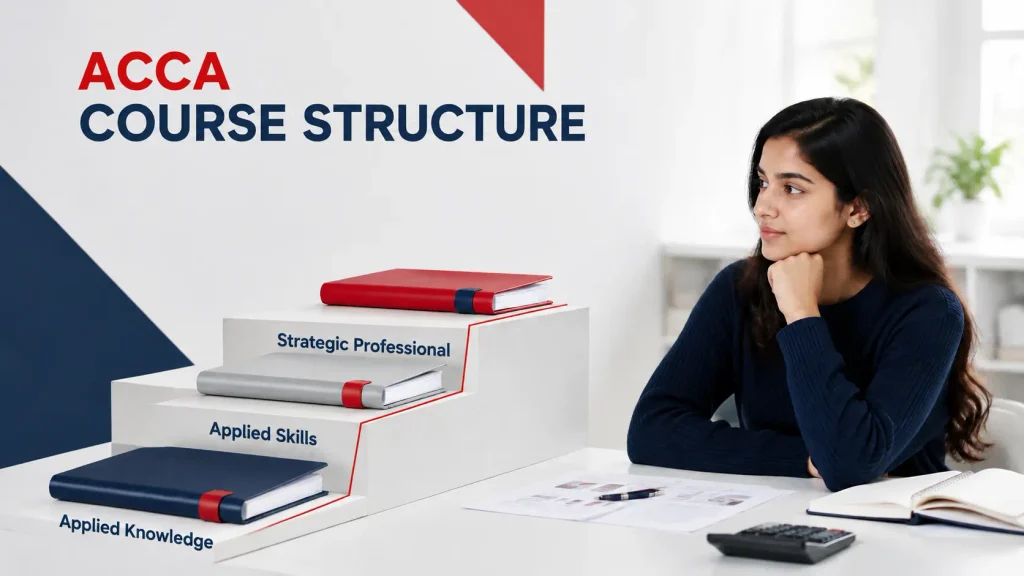
Complete ACCA Subjects List & ACCA levels
The complete ACCA subjects list contains 15 available paper titles. However, students complete a maximum of 13 exams because only two of the four Strategic Professional Options are required.
Applied Knowledge Level
The first of the three ACCA levels introduces accounting, business and management information.
| ACCA subject | Main area covered |
| Business and Technology (BT) | Business structure, governance, leadership, technology and ethics |
| Management Accounting (MA) | Costing, budgeting and performance measurement |
| Financial Accounting (FA) | Double-entry accounting and basic financial statements |
Applied Skills Level
These ACCA course subjects develop the technical knowledge required to handle practical finance and accounting problems.
| ACCA subject | Main area covered |
| Corporate and Business Law (LW) | Contracts, legal systems and company law |
| Performance Management (PM) | Budgeting, costing and performance evaluation |
| Taxation (X) | Tax rules for individuals and businesses |
| Financial Reporting (FR) | Accounting standards and financial statements |
| Audit and Assurance (AA) | Audit planning, evidence and internal controls |
| Financial Management (FM) | Investment, financing and financial risk |
Students preparing for FR can use FinTram’s ACCA Financial Reporting exam guide for syllabus and preparation guidance.
Strategic Professional Level
Strategic Professional develops leadership, professional judgement and the ability to solve complex business problems.
| Category | ACCA subjects |
| Compulsory Essentials | Strategic Business Leader and Strategic Business Reporting |
| Choose any two Options | Advanced Financial Management, Advanced Performance Management, Advanced Taxation or Advanced Audit and Assurance |
SBL and SBR are compulsory. The remaining two papers can be selected according to the student’s career direction.
Therefore:
3 Applied Knowledge + 6 Applied Skills + 2 Essentials + 2 Options = 13 exams
This explains why ACCA has 15 available subject titles but only 13 required examinations.
How Are ACCA Exams Conducted?
Applied Knowledge exams and certain versions of Corporate and Business Law may be available as on-demand computer-based exams. Their availability depends on the student’s country and selected examination centre.
Most Applied Skills and all Strategic Professional exams are session-based. ACCA conducts four exam sessions each year in March, June, September and December.
Students can attempt up to four exams in one examination cycle and no more than eight different exams in a calendar year. ACCA expects students to progress through the levels in order, although papers within the same level can be taken in a suitable sequence. The latest conditions are available on the official exam progression page.

How Long Does the ACCA Course Take?
The ACCA course usually takes around 2–3 years to complete, depending on exemptions, exam attempts, resits and study schedule. However, completing the exams is only one part of becoming an ACCA member; students also need to complete the ethics requirement and 36 months of relevant practical experience.
How Do ACCA Exemptions Work in Your Subjects?
ACCA exemptions are decided by comparing the subjects you have already studied with the ACCA syllabus. If your previous qualification covers the learning content of an ACCA paper, you may be eligible for an exemption from that paper.
For example, subjects related to financial accounting, management accounting, taxation, business law, auditing or financial management may be considered when ACCA assesses your qualification. However, studying a similar subject does not automatically guarantee an exemption.
The exact exemptions depend on your qualification, institution, programme and subjects studied. ACCA can award exemptions from Applied Knowledge and Applied Skills exams, while Strategic Professional exams do not have exemptions.
The best way to know which ACCA subjects you can skip is to enter your qualification details in the official ACCA Exemptions Calculator. You can also read FinTram’s ACCA exemptions guide for more information about eligibility, exemption fees and the process.
ACCA Subjects Exam Fees in India 2026
ACCA exam fees depend on the level of the paper:
| ACCA Exam | Standard Entry Fee |
|---|---|
| Applied Skills (per paper) | £151 |
| Strategic Business Leader (SBL) | £268 |
| Strategic Business Reporting (SBR) | £191 |
| Strategic Professional Options (per paper) | £191 |
Applied Knowledge exams (BT, MA, and FA) are generally taken through on-demand CBE centers, so the fee can vary by the selected center.
These are ACCA examination fees only. Registration, annual subscription, exemptions, and coaching fees are separate. Fees are charged in GBP, so the INR amount can vary with the exchange rate.
Students should check the official ACCA fees page for India before booking an exam.
What Is Required After the ACCA Exams?
Passing all required ACCA subjects does not automatically make someone an ACCA member. Students must also complete:
- The Ethics and Professional Skills Module
- At least 36 months of relevant work experience
- Nine performance objectives
- Approval from a practical experience supervisor
Relevant experience can be gained before, during or after the exams. Students who work and study together can complete part of their Practical Experience Requirement while preparing for the qualification.
What Do the Latest ACCA Pass Rates Show?
Pass rates change after every session and should not be treated as permanent difficulty rankings. According to the official June 2026 ACCA results, pass rates ranged from 89% for Business and Technology to 39% for Advanced Audit and Assurance.
| Acca Level | June 2026 pass rates |
| Applied Knowledge | BT 89%, FA 71%, MA 65% |
| Applied Skills | LW 82%, TX 55%, FR 52%, PM 41%, FM 48%, AA 47% |
| Professional Essentials | SBL 51%, SBR 47% |
| Professional Options | AAA 39%, AFM 47%, APM 42%, ATX 47% |
Lower pass rates generally show the importance of question practice, technical understanding, exam technique and time management.
What Career Options Are Available After ACCA?
ACCA students, affiliates and members can explore roles such as audit associate, financial reporting analyst, management accountant, tax consultant, internal auditor, FP&A analyst, risk analyst, finance business partner, and financial controller.
There is no official fixed ACCA salary. Current limited Glassdoor data for ACCA students in India reports an average of approximately ₹3.6 lakh per year. Actual salaries can be lower or higher depending on qualification status, experience, degree, city, employer and practical skills.
ACCA supports corporate and international finance careers, but it does not independently provide statutory audit-signing rights in India.

How Can You Start the ACCA Course?
Start by checking the entry requirements and available exemptions. Create an account on the official ACCA website, upload your identification and academic documents, pay the registration fee and wait for ACCA to confirm your paper list.
Do not plan or claim exemptions until they have been officially confirmed. After registration, select a realistic paper sequence based on your available study time and previous accounting knowledge.
Conclusion
Knowing all about ACCA means understanding more than its 13 exams. The complete journey includes eligibility, ACCA levels, subjects, exemptions, fees, ethics, and practical experience.
FinTram Global supports students through face-to-face, live online and flexible ACCA learning, along with exam preparation and career guidance. Students should confirm their official eligibility and exemptions before choosing their starting level.
Frequently Asked Questions
Can I pursue ACCA after Class 12?
Yes. Students who meet ACCA’s entry requirements can begin after Class 12. Those who do not qualify for direct entry can start through Foundations in Accountancy.
How many ACCA subjects are there?
There are 15 available subject titles under the current structure, but students complete a maximum of 13 exams because only two of four Strategic Professional Options are required.
Can I complete ACCA in one year?
A candidate with substantial exemptions may complete the remaining exams quickly. However, ACCA membership also requires the ethics module and 36 months of relevant experience.
Is practical experience compulsory?
Yes. Membership requires 36 months of relevant experience, nine performance objectives, and approval from a practical experience supervisor.
Which ACCA subject is the hardest?
There is no single hardest paper for everyone. In June 2026, AAA had the lowest pass rate at 39%, but difficulty depends on a student’s background, preparation, and exam technique.
What are the ACCA levels of exams?
The ACCA levels of exams are Applied Knowledge, Applied Skills and Strategic Professional. These levels cover progressively advanced areas of accounting, finance, taxation, audit and strategic decision-making.
What is the ACCA papers list?
The ACCA papers list consists of 3 Applied Knowledge exams, 6 Applied Skills exams and 4 Strategic Professional exams. At the Strategic Professional level, students complete 2 Essentials papers and choose 2 Options from 4 available papers.
What does the ACCA syllabus cover?
The ACCA syllabus covers subjects such as financial accounting, management accounting, taxation, financial reporting, audit and assurance, financial management, business law and strategic business topics. Each exam has its own detailed syllabus and study guide.
3 thoughts on “ACCA Subjects: Levels, Duration, Exam Fees and Careers”
Comments are closed.