 +91 8882677955
 +91 8882677955
How International Students Prepare for Global Finance Careers: Certifications + English Proficiency Tests

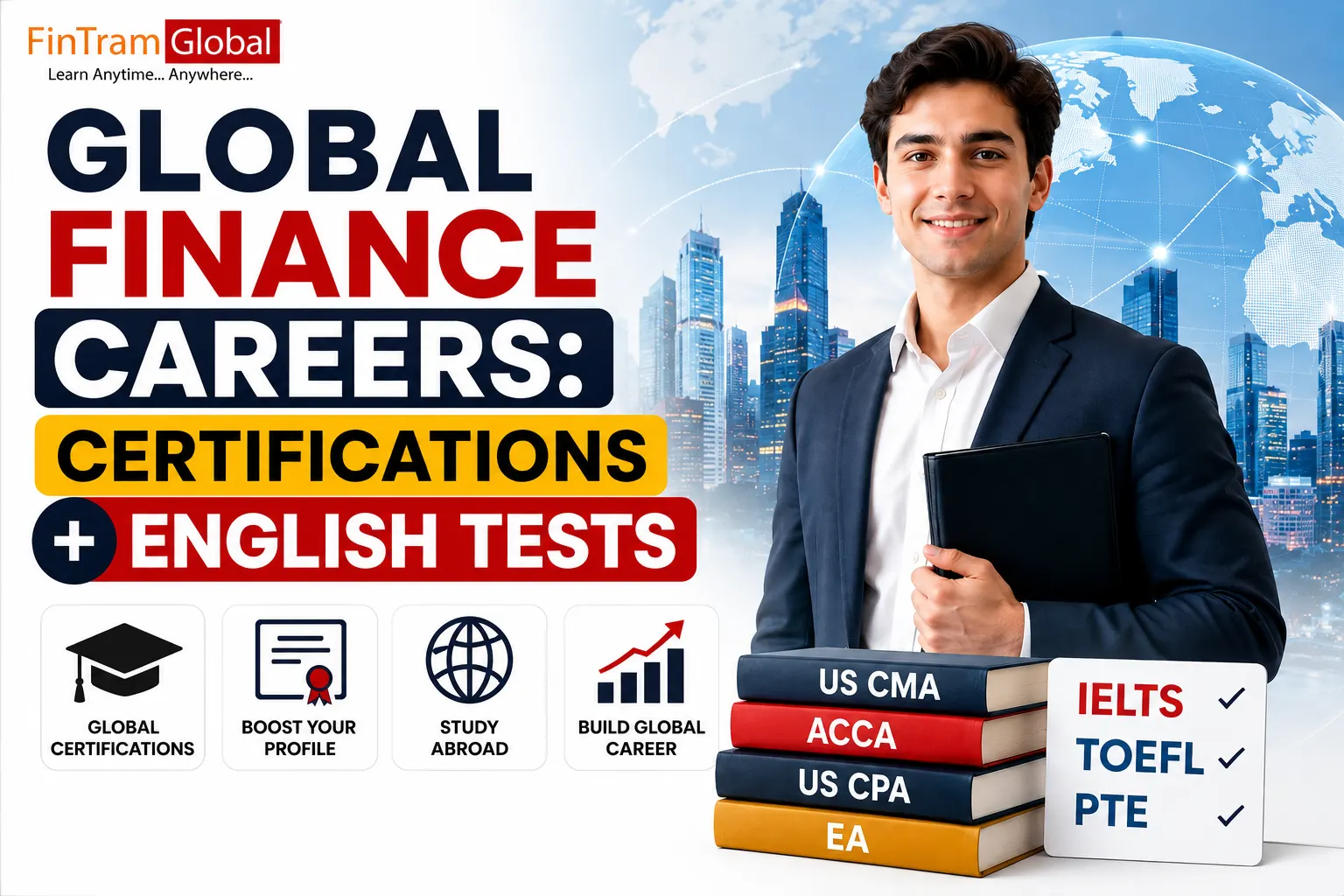
Most international students build a finance career plan for one credential when the market actually asks for two. The technical one is obvious: ACCA, US CPA, US CMA, EA, CFP or a Diploma in IFRS. The second is easy to postpone until it becomes urgent: proof of English proficiency, in a form a university admissions office, an immigration authority, or a Big 4 recruiter will accept.
Treating these as separate projects is the most common planning error, and it is expensive. A candidate can hold a globally recognised qualification and still lose a year because the language score arrived too late, expired, or came in below a threshold nobody checked in advance.
Why Global Finance Employers Ask for Both

A finance qualification proves what a candidate knows. An English score proves they can work in the language the file is written in.
That matters more in finance than in most fields. Audit is conversational; A junior spends the day asking a client’s controller why a reconciliation is out. Reporting under IFRS is written work read by people in three countries. FP&A is presentation and challenge. The technical knowledge is necessary but not enough on its own; the delivery mechanism is language.
This is also why the requirement follows candidates who never leave home. India’s global capability centers, shared service hubs, and offshore audit teams all serve overseas clients, and the parent entity sets their hiring standards. Whether the role is in Toronto or Gurugram, the English expectation travels with the client.
Track One: Choosing the Right Certification
The starting point should be the destination market and the role, not the shortest syllabus.
- ACCA: Carries the widest geographic recognition and suits candidates targeting audit, reporting, or advisory across the UK, Europe, the Middle East, and Asia. Prior study often earns exemptions, which shorten the route—ACCA exemptions are worth checking before enrolling rather than after.
- US CPA: The credential is for anyone pointed at the United States or at US-listed clients, and it is the recognised license for public accounting there.
- US CMA: Fits management accounting, cost control, and internal finance rather than assurance and moves faster than the licensure-track qualifications.
- Enrolled Agent: Is the specialist US taxation route and the most direct entry point into offshore tax delivery teams.
- CFP: Serves advisory and wealth management, where client conversation is the job.
- Diploma in IFRS: works as a focused add-on for professionals who already have a base qualification and need reporting depth.
The decision that matters is not which certification is hardest. It is the one the target employer actually recognises.
Track Two: The English Proficiency Test
Three tests dominate the applications international students file: PTE Academic, IELTS, and the Duolingo English Test. Which one to sit is determined by the receiving institution; a university, a professional body, and an immigration department may each accept a different set, and acceptance lists change.
Two rules hold across all of them.
- Check the specific threshold before booking anything: Requirements are set per program, per visa category, and sometimes per employer, and a score that clears one may fall short of another. A minimum overall score is often paired with a minimum in each section, which is where otherwise strong candidates get caught.
- Check the validity window: Language scores expire. A test taken at the start of a two- or three-year certification program may no longer be valid when the application is finally submitted.
The good news is that these exams reward preparation more predictably than professional papers do. They are format-driven, the task types repeat, the scoring criteria are published, and most of the improvement comes from familiarity rather than new knowledge.
For candidates whose target institution accepts PTE Academic, working through a dedicated PTE exam preparation platform with AI-based scoring, under timed conditions, is the fastest way to find which section is dragging the overall score down. It is usually not the section a candidate assumes.
Getting the Sequence Right
The order most students choose is to finish the certification, then take the English test, then apply.
The better order is usually the reverse for the language component. The English test is short to prepare for, and the score sits ready. The certification takes months to years. Clearing the language requirement early removes it as a bottleneck at the exact moment when applications, visa files and interviews all land at once.
A workable sequence looks like this:
1. Confirm the destination market and role, then select the certification that market recognises.
2. Identify which English test that market’s universities, regulators, and employers accept and the exact score required.
3. Sit the English test early enough that it remains valid at application and re-sit if a section falls short.
4. Begin certification study with the language requirement already cleared.
5. Apply with both credentials complete and neither waiting on the other.

Mistakes That Cost International Students a Year
- Assuming fluency equals a score: These tests measure performance against a rubric under time pressure, not conversational ability. Confident speakers routinely underperform on the first attempt.
- Ignoring section minimums: A strong overall result with one weak band can fail a requirement outright.
- Preparing without accurate feedback: Practice that isn’t scored the way the real exam scores it builds the bad habits and hides the actual weakness.
- Letting the score expire mid-qualification. Entirely avoidable, and entirely common.
The Combined Credential Is the Advantage
Neither credential is remarkable on its own. A recognised finance qualification is now the baseline for global roles, and an English score is a gate rather than a differentiator. Together, and in the right order, they remove the two most common reasons a strong application stalls.
Students building toward that combination are best served by treating the language requirement as the first task on the plan rather than the last and by choosing a certification based on where they intend to work, not on which syllabus looks shortest. FinTram Global’s course guides and career resources cover the certification side of that decision in detail.