 +91 8882677955
 +91 8882677955

Blog
How to Become an Enrolled Agent in 2026: Steps, Cost and Timeline


To become an enrolled agent (EA), you get a PTIN, pass all three parts of the IRS Special Enrollment Examination (SEE), apply for enrollment on Form 23 with a $140 fee, and clear the IRS suitability check. Obtaining an Enrolled Agent License allows qualified professionals to represent taxpayers before the IRS in tax-related matters. The IRS steps list no degree and no work experience. Plan on 6 to 12 months and at least $1,109.75 in IRS-side fees, before any prep course.
One thing changed this year, and many guides haven’t caught up. Since March 1, 2026, PSI Services runs the exam instead of Prometric, and each part costs $317, up from $267. If an article still quotes the old number, double-check everything else it says.
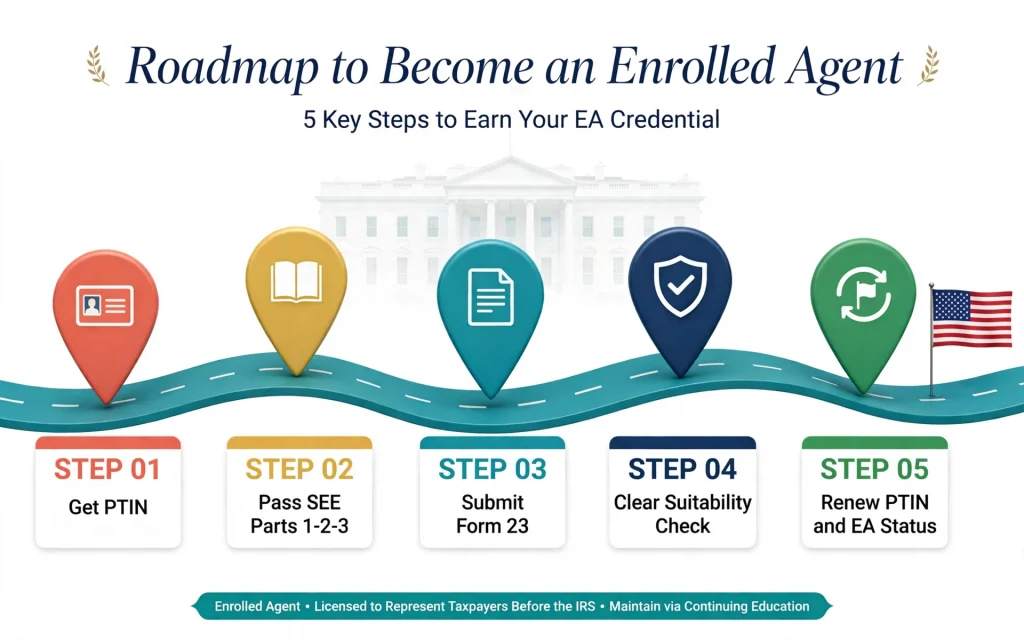
The 5 Steps to Get Your Enrolled Agent (EA) License
- Get a PTIN.
- Register with PSI and pass SEE Parts 1, 2 and 3.
- Submit Form 23 and pay the $140 enrollment fee.
- Clear the IRS suitability check.
- Renew your PTIN every year and your EA status every three years.
The IRS publishes the same sequence on its Become an enrolled agent page. The details below are where people lose time or money.
Step 1: Get your PTIN
A Preparer Tax Identification Number is the IRS ID for paid tax preparers. You need one before you can register for the exam, according to NAEA. The 2026 fee is $18.75 and it’s non-refundable. You apply on the IRS online PTIN system, and US applicants should keep last year’s return handy for the identity check.
Applying from outside the US without an SSN? Your route is different. You file Form W-12 together with Form 8946, add identity documents, and use a non-US physical address. A paper W-12 can take up to six weeks, and you can’t book an exam slot without the number. Apply early.
Step 2: Pass all three SEE parts
| Part | What it covers |
| Part 1: Individuals | Individual returns: filing status, income, deductions, credits |
| Part 2: Businesses | Business returns: entity types, accounting methods, depreciation, payroll |
| Part 3: Representation, Practices and Procedures | IRS procedures, audits, appeals, taxpayer rights, Circular 230 ethics |
Here is how the exam works, per the IRS enrolled agent FAQ:
- 100 questions per part. 85 are scored. 15 are unscored trial questions, and you won’t know which.
- 3.5 hours per part, roughly 4 hours in the chair once you add the tutorial and two 10-minute breaks.
- Closed book. Scratch paper, pencil and a calculator are provided at the test site.
- Scores run from 200 to 800. You need 500 to pass.
- Any order, any day. The parts don’t have to be taken together.
- Passing scores carry over for three years from the date you pass each part. After that, the part expires and you retake it.
- Testing window: May 1 to the end of February, with a March and April blackout while the IRS updates the exam. The 2026–27 US window runs July 1, 2026 to February 28, 2027.
A detail that saves you from studying the wrong material: the exam covers tax law as amended through December 31, 2025, and its questions refer to tax year 2025. Use 2025 forms and publications, not the 2026 versions.
For study time, prep providers such as Gleim estimate roughly 60 to 100 hours per part. At 8 to 10 hours a week, that’s about four to nine months of studying. Add scheduling gaps, a possible retake, and the IRS’s processing time after Form 23, and 6 to 12 months is a fair expectation.
Taking the exam from India or outside the US
This is where most guides go quiet, so read it before you plan dates. As of the IRS FAQ’s October 2026 update:
- International testing is remote-proctored only. There is no in-person international testing.
- International scheduling and testing is currently delayed, with no new start date. The IRS had expected scheduling to open on September 1, 2026.
- Remote testing is currently open only to candidates physically in the US at the time of the exam. Giving a false location can void your scores and bar you from future exams.
- For international candidates, passed parts that would expire after May 1, 2026 are extended until international testing resumes.
What you can do now: study, and get your PTIN. If you can travel, you can book a domestic appointment through PSI. Before you pay for anything, check PSI and the IRS FAQ again. These dates have already shifted once this year.
Step 3: Apply for enrollment with Form 23
You must apply within one year of passing the third part. Apply online through Pay.gov and pay $140, or mail the Form 23 PDF with a check. The IRS says it aims to finish within 60 days for exam candidates.
Step 4: Clear the suitability check
The IRS reviews two things before it enrolls you.
Tax compliance. Unfiled returns and unpaid taxes can sink an application, unless you have an acceptable payment arrangement.
Criminal record. In general, a felony under federal tax law, or a felony tied to dishonesty or a breach of trust, counts against you if it’s under ten years old.
The rules sit in Circular 230, sections 10.5(d)(1) and 10.51. If you have overdue returns or a balance due, fix that before you apply, not after.
Step 5: Keep your status
- PTIN: renew every year.
- EA status: renew every three years on Form 8554. Your cycle depends on the last digit of your SSN, per the IRS maintenance page.
- Continuing education: 72 hours per three-year cycle, at least 16 each year, and 2 of those 16 must be ethics. Use an IRS-approved provider.
- Your first renewal is prorated: two hours for each month you were enrolled, including 2 ethics hours each year, instead of the full 72.
What it costs
| Item | Cost (USD) |
| PTIN (2026) | $18.75 |
| SEE exam, per part | $317 |
| SEE exam, all three parts | $951 |
| Form 23 enrollment fee | $140 |
| Minimum IRS-side total | $1,109.75 |
A prep course, continuing education, and any retakes come on top. Each retake means paying $317 again, because the fee is due when you book. Confirm current figures on the IRS FAQ before you budget, since the exam fee changed in April 2026.
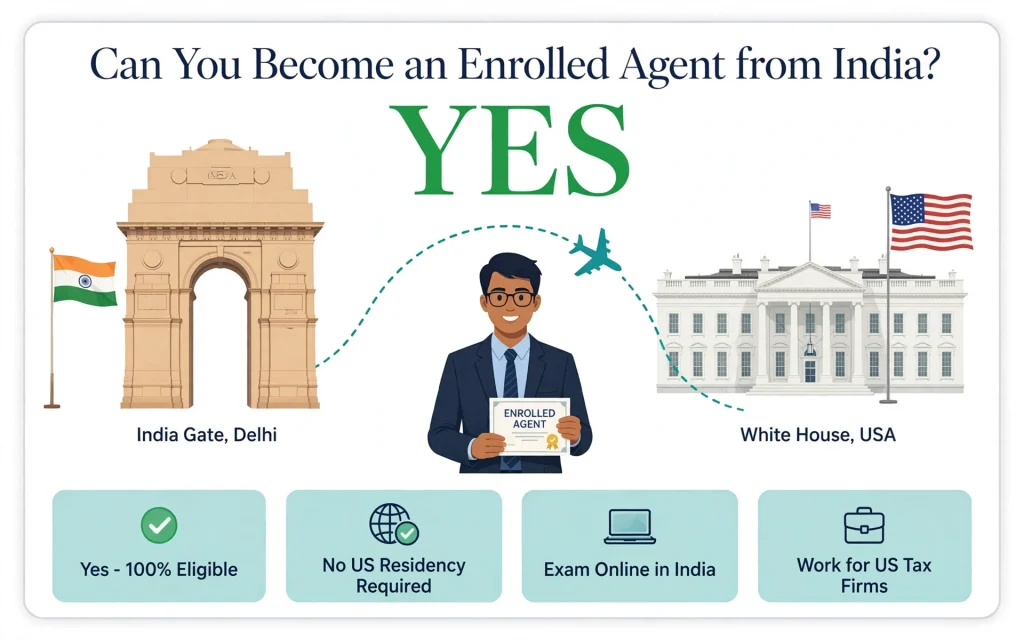
Can You Become an Enrolled Agent from India?
Yes, Indian candidates can pursue the Enrolled Agent (EA) qualification without relocating to the United States. However, the main challenge is currently the availability of the EA examination for candidates outside the US.
1. Can Indian Candidates Take the EA Exam from India?
As of November 10, 2026, the IRS has temporarily delayed international scheduling and testing for the Special Enrollment Examination (SEE). Although international examinations are planned to be conducted through remote proctoring, the IRS has not announced a new start date.
Currently, remote examinations are available only to candidates who are physically present in the United States. This means candidates cannot take the SEE remotely from their homes in India at present.
2. Can Indian Candidates Travel to the USA to Take the EA Exam?
Yes. Indian candidates may consider travelling to the United States and taking the examination at an authorised PSI test centre, subject to appointment availability and applicable testing requirements.
Candidates should plan their travel only after confirming their examination appointment. They should also remember that US remote testing requires them to be physically present in the United States during the examination.
3. What Should Indian Candidates Do While Waiting for International Testing?
The international testing delay does not mean candidates need to stop their preparation. They can use this time to strengthen their understanding of US taxation and prepare for all three SEE parts.
Some practical steps include:
- Study the syllabus for Individuals, Businesses, and Representation, Practices and Procedures.
- Understand US federal tax rules using relevant IRS publications and resources.
- Practise multiple-choice questions and mock examinations.
- Identify weak topics and revise them regularly.
- Follow official IRS announcements for updates on international examination scheduling.
For Indian candidates, the best approach is to continue preparing while monitoring official examination updates. This will help them make use of the waiting period and be better prepared when international testing resumes.
Is the credential worth it?
An enrolled agent license, like attorneys and CPAs, are generally unrestricted in whom they can represent, which tax matters they can handle, and which IRS offices they can appear before. That’s the whole pitch: audits, collections and appeals work, on a credential that tests federal tax only.
Still comparing? Our guides to EA vs US CPA and Enrolled Agent vs ACCA lay out the trade-offs, and seven reasons to pursue the EA covers the career side.
Expert Advice: Can You Practice After Passing EA Part 1?
Passing Part 1 of the SEE is an important milestone, but it does not make you an Enrolled Agent. You must pass all three exam parts, submit Form 23, and receive IRS approval before practising as an EA.
Expert Tip: Don’t confuse passing an individual exam part with earning the licence. Use the time between exams to strengthen your US taxation knowledge and practise applying tax rules to real-world situations. This will help you prepare for the remaining exams and your future career in US taxation.
Where Fintram Global fits
If you’d rather not self-study, Fintram Global’s Enrolled Agent course offers live online and classroom batches in Delhi NCR, recorded classes, and Gleim study content with mock exams. Not sure you qualify? Start with the EA eligibility guide, then read the EA exam guide for a part-by-part breakdown. More tax-career reading lives in our US taxation section.
FAQs
1. Can I become an enrolled agent without a degree?
Yes. The IRS does not require a specific college degree or prior work experience for candidates following the standard SEE examination route. You must pass all three exam parts, submit Form 23, and meet the IRS suitability requirements.
2. How long does it take to become an Enrolled Agent?
Many candidates may need around 6 to 12 months for preparation and the examination process. The actual duration depends on study hours, exam availability, retakes, and IRS application processing. International testing delays can extend the timeline for candidates outside the US.
3. Can I take the Enrolled Agent exam from India?
As of November 2026, international SEE scheduling and testing are temporarily delayed. Remote examinations are currently available only to candidates physically present in the United States. Indian candidates should check the latest IRS announcement before planning their examination.
4. How much does it cost to become an Enrolled Agent in 2026?
The basic IRS-side cost is approximately $1,109.75. This includes the $18.75 PTIN fee, $951 for all three SEE parts, and the $140 Form 23 enrollment fee. Coaching, study materials, retakes, travel, and continuing education are additional expenses.
5. How many exams do you need to pass to become an EA?
You must pass all three parts of the Special Enrollment Examination: Individuals, Businesses, and Representation, Practices and Procedures. You can take the parts separately and in any order.